What is a Rain Garden?
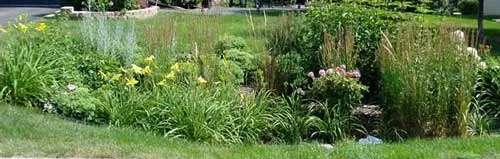
A rain garden is a garden of native shrubs, perennials, and flowers planted in a small depression, which is generally formed on a natural slope. It is designed to temporarily hold and soak in rain water runoff that flows from roofs, driveways, patios or lawns. Rain gardens are effective in removing up to 90% of nutrients and chemicals and up to 80% of sediments from the rainwater runoff. Compared to a conventional lawn, rain gardens allow for 30% more water to soak into the ground.
A rain garden is not a water garden. Nor is it a pond or a wetland. Conversely, a rain garden is dry most of the time. It typically holds water only during and following a rainfall event. Because rain gardens will drain within 12-48 hours, they prevent the breeding of mosquitoes.
Why is Rainwater Runoff a Problem?
Every time it rains, water runs off impermeable surfaces, such as roofs or driveways, collecting pollutants such as particles of dirt, fertilizer, chemicals, oil, garbage, and bacteria along the way. The pollutant-laden water enters storm drains untreated and flows directly to nearby streams and ponds. The US EPA estimates that pollutants carried by rainwater runoff account for 70% of all water pollution.
Rain gardens collect rainwater runoff, allowing the water to be filtered by vegetation and percolate into the soil recharging groundwater aquifers. These processes filter out pollutants.
What Makes a Rain Garden Different from a Traditional Garden?
 In the design of a rain garden, typically six to twelve inches of soil is removed and altered with tillage, compost and sand to increase water infiltration. The type of alteration to the soil depends on the current soil type, so it is a good idea to obtain a soil test.
Rain gardens are generally constructed on the downside of a slope on your property and collect rainwater runoff from the lawn, roof and/or the driveway. Once water collects in the rain garden, infiltration may take up to 48 hours after a major rainfall. Also, rain gardens incorporate native vegetation; therefore, no fertilizer is needed and after the first year, maintenance is usually minimal.
What Benefits Do Rain Gardens Provide My Community?
- Improves water quality by filtering out pollutants
- Aesthetically pleasing
- Preserves native vegetation
- Provides localized stormwater and flood control
- Attracts beneficial birds, butterflies and insects
- Easy to maintain after establishment
What Types of Plants Thrive Best in a Rain Garden?
 As a rule, native vegetation should be incorporated into a rain garden. Native plants don’t require fertilizer, have good root systems, and are better at utilizing the water and nutrients available in their native soils than non-native species. Perennials, shrubs, wildflowers, or a mixture of all three can be planted. Check with your local nursery for a list of rain garden approved plants for your hardiness zone, or search the rain garden plant database.
As a rule of thumb avoid planting trees in your rain garden, as trees generally absorb more water than surrounding plants. Also, never plant invasive or noxious species in a rain garden, such as purple loosestrife.
What is the Average Size and Placement of a Rain Garden?
A rain garden should have an area about 20% the size of the roof, patio, or pavement area draining into it. A typical rain garden for a residential home or small building is between 100 and 400 square feet. Regardless of the size, big or small, each rain garden can make an impact.
Rain gardens are shaped longer than they are wide and positioned perpendicular to the slope of the land in order to catch the maximum amount of rainfall. Rain gardens should be placed at least 10 feet away from building foundations and should not be located where water ponds for an extended period of time.
What Makes a Suitable Site for a Rain Garden?
- The site is fed by one or two downspouts
- Soil tests show the site does not have heavy clay soils (conduct a ribbon soil test)
- Infiltration tests show the site infiltrates water one-half inch per hour or more (conduct an infiltration test)
- The water table is at least 2 feet from the surface at its shallowest
- The slope of the site is not more than 12%
- The site is at least 10 feet from buildings with basements
- The site is not over any utilities (contact your local diggers hotline)
- The site is not over or near a septic tank, drainfield, or wellhead
- The site does not interfere with any trees. If there are trees in the area, make sure they can handle wet soil conditions for lengthy periods of time.
If the site that you have chosen does not meet all of the above criteria, it does not necessarily mean that a rain garden cannot be established there. Speak with a professional landscaper to review your options.
What is the Typical Cost to Install a Rain Garden?
 The cost of a rain garden is dependant on the property’s soil type, the size of roof/driveway/patio draining into a rain garden, and the types of plants chosen. If the soil is high in clay content, it may be a good idea to install an under drain system to prevent standing water in the rain garden for more than 48 hours.
For a self-installed rain garden, expect to pay between $3 and $5 per square foot in plant costs and soil amendments (peat moss, for example, should be mixed in to soil with high levels of clay). When working with a landscaping company to design and install your rain garden, the cost will significantly increase to around $10 to $15 per square foot.
What Kind of Maintenance Does a Rain Garden Require?
When native plants are used, your rain garden will not require pesticides or fertilizer. As the rain garden is establishing during the first and second year or during periods of little to no rainfall, occasional watering of the plants may be necessary. Likewise, weeds will need to be removed while dead plants may need to be replaced. Once the plants in the rain garden have become established and grow larger, they will eventually out-compete the weeds.
Can I Build a Rain Garden By Myself?
 Absolutely! Building it yourself will save you money and provide you with a greater sense of accomplishment. Many homeowners finish their rain garden in one afternoon. Digging the garden is the most time consuming task, as 6-8 inches of soil depth is typically removed to add amendments. Involve your entire family or invite the neighbors over and make a party out of it.
To get started, we recommend you conduct a soil test and an infiltration test. You can do both of these tests yourself which will ensure the success of your rain garden.
Infiltration Test:
Dig a hole about 6-12 inches deep and at least 4 inches in diameter in the rain garden site (roughly the size of a coffee can). Fill the hole with water and let it sit for an hour or two to pre-wet the soils for your test. Then refill the hole with water and push a popsicle stick into the side of the hole to mark the water level. After an hour, measure and record the depth of the water again. You may want to continue taking measurements at hourly increments for a few more hours. If the water level dropped one-half inch or more; this is a perfect site for a rain garden but you might still want to consider soil amendments (like peat moss). If the water level dropped less than one-quarter of an inch; you will have to amend your soils or try another site.
Ribbon Soil Test:
Collect a few teaspoons of soil from 4-6 inches beneath the surface. Place about 2 teaspoons of soil in the palm of your hand and add drops of water until the soil has reached a consistency that makes it moldable, like moist putty. Knead the soil as you add the water drops. Form the soil into a ball and place the ball between your thumb and forefinger. While gently pushing the soil with your thumb, squeeze the soil upward into a strip of uniform thickness and width. Allow the strip, or ribbon, to emerge and extend over your forefinger until it breaks from its own weight. If the soil could not remain in a ball form; you have sandy soil. If the soil formed a ribbon less than 1 inch long before it broke; you have silty soil. If the soil formed a ribbon 1-2 inches long before it broke; you have slightly clayey soil. But if the soil makes a ribbon greater than 2 inches before it breaks, then you have highly clayey soil which is not a suitable for a rain garden.
 Refer to the list of links below to guide you through calculating garden depth, garden size, placement, and plant selection.