Emerging contaminants · Field questions, explained
PFAS in Groundwater: What the “Millions at Risk” Headlines Really Mean
Separate national predictions, raw-water detections, and household results before deciding what a PFAS headline means for your supply.
The phrase “PFAS in drinking water” can describe several very different things: a chemical detected in an untreated aquifer, a prediction about where detections are likely, a sample collected at a treatment plant, or a result from a household tap. Those distinctions are easy to lose when a national headline becomes a conversation about one kitchen. They matter because each observation supports a different decision. A map can guide an investigation. A properly collected sample can describe water at a particular place and time. Neither automatically explains an entire water supply system.
This guide follows a hypothetical reader who sees a national estimate and wants to understand whether it applies locally. The example is an editorial exercise, not a report of sampling by this website. Its purpose is to show how to move from an attention-grabbing claim to a useful question, without assuming that a broad estimate is either meaningless or a diagnosis of every well inside a colored area.
What the national estimate actually describes
In October 2024, the US Geological Survey reported that an estimated 71–95 million people in the contiguous United States could rely on untreated groundwater with detectable PFAS. That is an estimate about source water and populations potentially served by it. It is not a count of people whose treated tap water was individually tested and found above a legal limit.
The associated Science research paper uses predictive modeling at drinking-water supply depths. This is useful because direct sampling cannot cover every location. It also introduces assumptions about the relationship between measured locations and unmeasured ones. Before sharing the population number, keep three qualifiers attached: estimated, untreated groundwater, and the study's geographic coverage. Removing any one of them changes the meaning. A local utility may use groundwater, surface water, or a blend, and treatment may change what reaches consumers.
Detection, concentration, and comparison are separate questions
“Detected” means that an analytical method identified a substance according to its reporting rules. It does not, by itself, tell a reader the concentration, the uncertainty, or the benchmark against which the result should be compared. A headline about any PFAS detection may combine chemicals with different analytical sensitivities and different regulatory treatment. Readers should resist turning that category into a single concentration or a single health conclusion.
Ask for the actual laboratory report rather than a screenshot of a map legend. Identify the chemical names, units, sample location, collection date, analytical method, and reporting limits. Look for qualifiers explaining uncertain measurements or results below a laboratory's normal quantification range. If a comparison value is presented, ask which authority issued it, whether it concerns that specific chemical, and whether it applies to the sampled water. A source-water research result and a compliance result can both be valuable while answering different questions. A qualified laboratory or responsible water authority can explain the appropriate interpretation for the jurisdiction.
Start by identifying the water supply
For a household connected to a public supply, the first practical document is information from the operator about its sources, sampling, and treatment. A street address does not reveal which aquifer supplies the tap. Distribution boundaries may differ from municipal boundaries, and a utility may change its source mix seasonally. Record the operator's name and the period covered by any published results before comparing them with a regional groundwater map.
For a private well, collect the construction record if it exists. Well depth, screened interval, nearby land uses, and past test results help frame a conversation with a local health agency and a qualified laboratory. A neighbor's result may justify questions, but it does not substitute for sampling a different well. Two properties can draw from different depths or flow paths. Conversely, a negative result from a single neighbor cannot establish that nearby wells are unaffected. The useful next step is a testing plan tied to the actual source, not an argument about whether national research should be ignored.
A map is a prioritization tool
Imagine a county map showing a higher modeled probability in one district than another. A sensible response is to ask whether the district has been sampled adequately, which supply depths were represented, and whether local records support the pattern. An unsound response is to label every property in that district contaminated. Another unsound response is to promise that every property outside it is free of PFAS.
Maps aggregate information into cells, zones, or aquifer units. Household decisions occur at points with specific construction and operating conditions. There may also be important local sources that a national model cannot resolve. When communicating a map, show the legend, study date, prediction target, and uncertainty alongside the colors. If an agency uses the map to prioritize sampling, report the follow-up results separately from the model output. Maintaining those two evidence layers makes it possible to learn where the model performs well and where additional investigation is needed.
Sampling needs a question and a protocol
A useful sampling question might be: what are the reported concentrations of a specified PFAS panel in untreated water from this well? Another might concern water delivered after an existing treatment device. These are different sample locations. Labeling both bottles “home water” would make the final report harder to interpret. Decide the question with the laboratory before collecting anything.
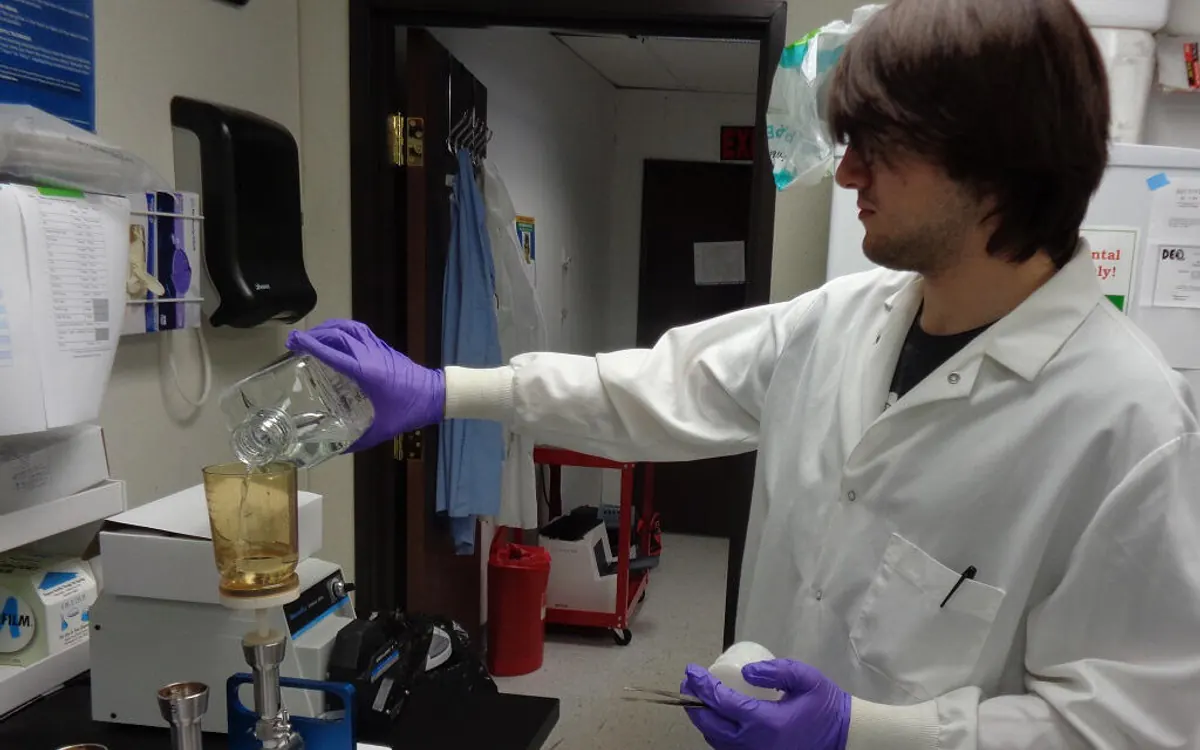
PFAS analysis requires particular attention to the laboratory's collection instructions, containers, handling, and contamination controls. Do not improvise a container or transfer a sample between household bottles. Ask whether the laboratory is qualified for the method and purpose involved, what substances its panel includes, and how results will be reported. Document treatment status, collection point, and collection time. A carefully planned sample may cost more effort initially, but it avoids the much larger confusion of paying for data that cannot answer the intended question. This website does not provide a substitute field protocol or certify sampling personnel.
Treatment claims need their own evidence
Discovering a PFAS concern often leads immediately to advertisements for filters. A responsible purchasing conversation begins with the target chemicals, source-water result, expected water use, and applicable performance certification. A device described as improving taste is not automatically demonstrated to address the substances on a PFAS report. Likewise, a general technology name does not establish how a particular product performs over its service life.
Ask a supplier what independent performance evidence applies to the exact model, under what conditions, and with which replacement requirements. Include installation, maintenance, disposal, and confirmatory sampling in the cost discussion. If a public operator is evaluating treatment, the engineering questions extend beyond an individual household device to capacity, residuals, source variability, and monitoring. Avoid claiming a percentage reduction without explaining the tested conditions. Local public-health advice should guide interim water-use decisions when a result raises concern. Treatment selection is a separate technical task from interpreting a national occurrence map.
Compare results without manufacturing a trend
Suppose an illustrative well has one result from 2024 and another from 2026. A larger reported number does not automatically establish a worsening aquifer. The laboratory methods, chemical panel, reporting limits, sample points, and treatment configuration may have changed. Check those details before drawing a line between two numbers. If the earlier report did not analyze a substance, a later detection is not evidence that the substance arrived only recently.
A small comparison table should preserve the original chemical name, value, unit, qualifier, method, date, and sampling point. Keep nondetects as censored observations with their reporting limits rather than replacing them with zero. If methods are not comparable, state that plainly and avoid presenting a percentage change. Repeated, consistently collected observations can support a stronger interpretation, especially when they are accompanied by records of pumping, treatment maintenance, and relevant site changes. The honest conclusion may be that more comparable observations are needed, which is more useful than a false trend.
Communicating risk without losing the evidence
A community update should separate what is known, what is inferred, and what will happen next. For example: a model suggests sampling priority; a specified laboratory panel has been ordered; results will be reviewed by the responsible agency; and residents will receive an explanation of the findings. This sequence gives people a practical path through uncertainty. It avoids both an unsupported reassurance and an alarming claim that outruns the data.
Consider who is missing from the information chain. Private-well users may not receive utility notices. Renters may not control sampling or treatment decisions. People reading a translated summary may see only the headline. Provide the sample date and location type in plain language, make the underlying report accessible where privacy permits, and identify the organization responsible for follow-up. Do not publish a household's exact well location or personal details without permission. Good communication is part of data quality because misunderstandings can persist long after the original map has been corrected.
The question to carry forward
The most productive response to a large PFAS headline is not “Is this number frightening?” but “What evidence would connect this finding to the water supply I actually use?” That question leads to source identification, an appropriate sampling plan, careful reading of laboratory reports, and a discussion with the responsible local authority. It also keeps research in its proper role: identifying patterns and directing attention, rather than replacing every local investigation.
Keep a simple evidence folder with the national study, local source information, complete laboratory reports, and any written guidance you receive. Record when each document was reviewed. If new research or local data become available, update the conclusion rather than merely attaching another dramatic headline. PFAS occurrence research is important precisely because it can improve decisions. Its value is greatest when its scope, uncertainty, and relationship to actual water use remain visible from the first paragraph to the final action.
When forwarding a local result, attach the full report rather than a cropped concentration row. Missing pages can contain the sample identification, qualifiers, or method notes needed for interpretation. Remove personal information where appropriate, but keep the technical context intact. If a correction is issued, distribute it through the same channels used for the original message. This helps prevent an early misunderstanding from becoming the version that continues circulating after the evidence has been clarified.
Methodology, sources, and limitations
Method: Desk-based explanation using the primary sources below, checked on November 14, 2026. Examples and workflows are hypothetical unless explicitly attributed. No original field campaign, laboratory analysis, interviews, or independent expert review are claimed.
Scope: Separate national predictions, raw-water detections, and household results before deciding what a PFAS headline means for your supply. Findings apply only within each source’s stated setting, methods, and date. This guide does not certify a supply, diagnose exposure, or replace a qualified local assessment.
Read our editorial standards and correction and contact status. Review date: .