Geogenic contaminants · Field questions, explained
Clear Water, Hidden Arsenic: Why a Nearby Well Cannot Tell You Your Result
Understand the roles of geology, depth, laboratory units, and sampling context when investigating arsenic in a water source.
Clear water can contain substances that are not apparent to sight, smell, or taste. Arsenic is an important example because its occurrence can reflect the geology and chemistry of an aquifer rather than an obvious spill. A well owner may reasonably assume that remote land, clean surroundings, or decades of ordinary-looking water mean there is nothing to investigate. Those observations do not replace an appropriate laboratory analysis.
This guide examines the evidence needed to move from a regional arsenic concern to a meaningful assessment of a particular water source. It uses a hypothetical well-review workflow and does not report new sampling. It is not a medical assessment or a treatment specification. For decisions about water use, testing, or exposure, obtain advice from the responsible health authority and qualified water professionals. The useful starting point is curiosity about the actual water source, not an assumption based on its appearance.
Geology changes the starting question
The World Health Organization's arsenic overview explains that arsenic occurs naturally in the environment and that contaminated groundwater can be an important exposure route. “Natural” describes an origin; it does not mean that a substance is harmless or that testing is unnecessary. Conversely, a regional geological association does not prove that every well in that region has the same concentration.
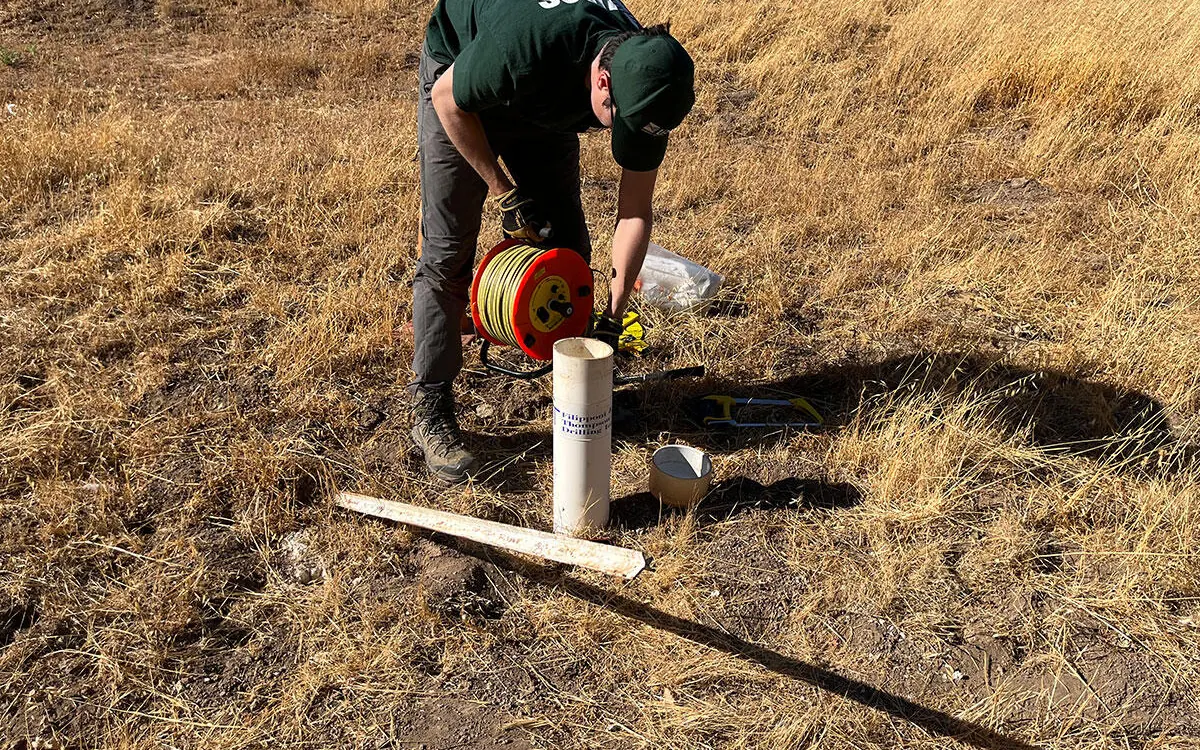
When preparing to test, gather the well's location, construction record, screened interval if known, and previous laboratory results. These records help specialists connect the sample to an aquifer setting. They also prevent confusion between a shallow household well and a deeper supply nearby. A regional map can help prioritize investigation, but it is not a personal certificate. The important transition is from a broad geological question to a sample representing the water people actually use, with enough context to interpret what that sample can and cannot establish.
Nearby wells may tell different stories
A neighbor's result is useful context, especially when it prompts a well owner to seek advice. It is not a direct measurement of another household's supply. Wells separated by a short distance may intercept different materials, depths, or flow paths. Construction and pumping can also differ. A map based on sparse data may make these differences appear smoother than they really are.
For a community investigation, retain individual well identifiers and depth information rather than merging all observations into a neighborhood average. An average can conceal both higher and lower results. Record where information is missing and avoid treating untested areas as low-concentration areas. When sharing findings, explain how many wells were sampled, why they were selected, and whether their construction represents other local supplies. These details make the difference between a useful screening exercise and an unsupported claim about every resident. Privacy matters too: precise household locations should not be published without permission merely because the chemical data are interesting.
Choose the sample to match the decision
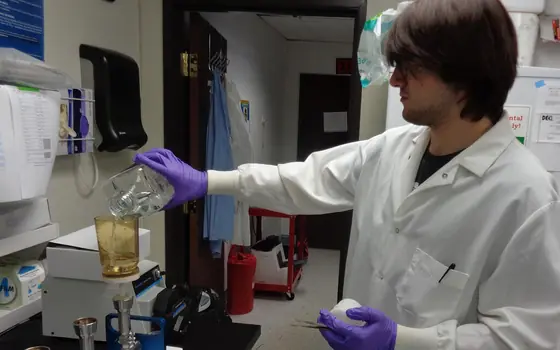
Testing untreated well water can help characterize the source. Testing after treatment can help evaluate the water delivered at that point. A tap sample may also reflect plumbing and operational conditions. These are related questions, but they should not be combined under a vague label such as “the well tested fine.” Decide with a qualified laboratory which sample locations and methods are appropriate.
Before collection, ask about containers, handling, preservation, timing, and the form of the final report. Follow the laboratory's actual protocol. If treatment is installed, document its type and operating condition, and ask whether paired samples are appropriate for the question. Keep the sampling record with the report. An analytically precise result loses much of its practical value if nobody knows whether the sample was collected upstream or downstream of a treatment device. Planning the comparison in advance is more reliable than trying to reconstruct those details after a surprising number appears.
Read the units and benchmark together
Arsenic results are often expressed in micrograms per litre, while some reports use milligrams per litre. Those units differ by a factor of one thousand. For example, a hypothetical result of 0.008 milligrams per litre is equivalent to 8 micrograms per litre. That calculation changes the unit, not the concentration. Retain the original value and label any conversion clearly.
The WHO chemical fact sheet provides the basis and limitations of its provisional guideline value of 10 micrograms per litre. Use the applicable local requirements when interpreting an actual supply; international guidance and enforceable national rules are not interchangeable. Ask the laboratory or authority how measurement uncertainty, qualifiers, and the particular result should be handled. A value close to a comparison point deserves careful interpretation rather than arbitrary rounding. No online article can turn a single number into a complete assessment of a person's exposure history or health.
Chemistry can explain patterns without identifying every cause
Arsenic behavior is connected to groundwater chemistry and the materials water encounters. A specialist may consider conditions such as pH, oxidation-reduction state, and associated constituents when interpreting results. These variables help develop explanations, but they do not justify diagnosing a well from one field measurement. A low-cost meter reading cannot replace an arsenic analysis.
If a study proposes a chemical mechanism, ask whether its supporting measurements were made in the same aquifer, depth range, and period as the arsenic observations. Check whether alternative explanations were considered. A convincing conceptual model should state where evidence is strong and where inference remains uncertain. For practical management, the immediate need may be a verified source-water result and a professionally evaluated water-supply option, even while the geological explanation remains incomplete. Separating management from full scientific attribution allows protective decisions to proceed without pretending that every process underground has already been resolved.
Repeated data need consistent context
A well owner may want to know whether arsenic is increasing. The question requires more than arranging old and new laboratory numbers in date order. Check sample location, analytical method, reporting limit, treatment status, and well operation. If one result represents untreated water and another represents water after a newly installed device, the difference is not an aquifer trend.
Maintain a timeline that marks repairs, changes in pumping, new treatment, and changes in sample collection. Preserve nondetects with their limits rather than substituting zero. Ask a qualified professional what repeat-testing schedule is appropriate for the local setting and the decision being made. Do not infer a long-term trend from two inconsistent observations. A well-organized record can still be useful when it does not demonstrate a trend: it can show which comparisons are valid, where the information gap lies, and what a better follow-up sample should be designed to establish.
Treatment evaluation is a separate investigation
When a result raises concern, households may encounter strong claims about filters, media, or whole-house systems. The relevant question is whether a specific option is demonstrated to address the actual source water and the intended use. Ask for independent performance evidence, the conditions under which it applies, maintenance requirements, and a plan for checking water after installation.
Avoid assuming that a device that improves clarity or taste necessarily addresses arsenic. A treatment proposal should explain what will be monitored and what happens if performance changes. Costs include installation, replacement materials, servicing, waste handling where relevant, and laboratory verification. Discuss alternatives with the responsible local professionals rather than treating a product advertisement as a complete water-safety plan. This article does not select a technology or guarantee removal. Its role is to help readers ask for evidence that connects the proposed system, the source-water characteristics, and the water people will actually consume over time.
A regional study has a defined population
In 2026, the USGS summarized research on geogenic contaminants in drinking-water aquifers. Such studies are valuable for understanding broader patterns, including the occurrence of more than one naturally derived constituent. They should be read with attention to the aquifers, sampling periods, and well types represented. A national summary is not a local sampling record.
When a news story gives a percentage, ask “percentage of what?” It may concern sampled wells, an estimated aquifer area, or a population served by particular sources. Those denominators cannot be exchanged without changing the claim. Look for study-selection criteria and the treatment stage of the water sampled. A result from a public-supply source well does not automatically characterize a nearby domestic well or water after treatment. Keeping the denominator visible makes a large study more useful, because readers can recognize the settings where its conclusions are informative and the settings where local evidence is still needed.
Communicate the result without stigma or false reassurance
Communities need clear information about the sample, the interpretation, and the available next steps. Avoid describing a household as careless because a naturally occurring constituent was detected. Avoid describing an entire region as unsafe because a screening map shows elevated probability. Both statements outrun the evidence and can make people less willing to participate in follow-up monitoring.
A useful public summary states what was tested, where the sample was taken in the supply system, when it was collected, which authority or professional interpreted it, and what action is recommended locally. Provide access to underlying reports where privacy permits. Explain what remains unknown, including untested wells or unmeasured constituents. Clear water is not evidence of absence, but neither is uncertainty a reason to invent a conclusion. The strongest response combines appropriate testing, respectful communication, and a documented plan that can be revised as better local information becomes available.
Keep a written list of the questions that remain after the first consultation. These might concern an unclear sample point, a missing construction record, or the timing of a professionally recommended repeat test. Assign a responsible contact and a follow-up date to each practical task. This simple record prevents an important concern from disappearing between conversations and helps a future owner or manager understand which issues were resolved with evidence and which still require qualified attention.
Methodology, sources, and limitations
Method: Desk-based explanation using the primary sources below, checked on November 14, 2026. Examples and workflows are hypothetical unless explicitly attributed. No original field campaign, laboratory analysis, interviews, or independent expert review are claimed.
Scope: Understand the roles of geology, depth, laboratory units, and sampling context when investigating arsenic in a water source. Findings apply only within each source’s stated setting, methods, and date. This guide does not certify a supply, diagnose exposure, or replace a qualified local assessment.
Read our editorial standards and correction and contact status. Review date: .